
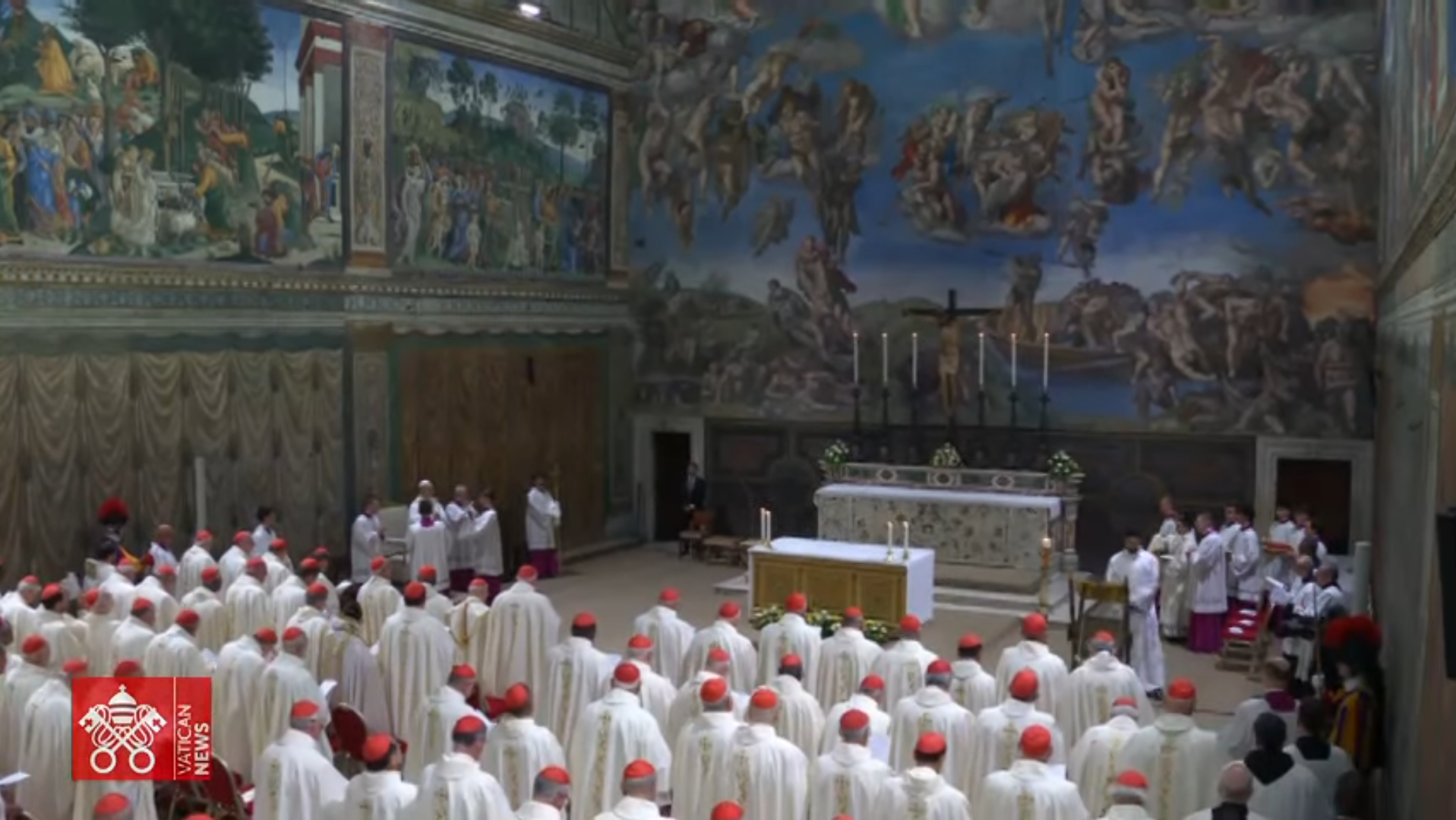
In his first homily as pope, delivered during a Mass with the College of Cardinals in the Sistine Chapel, Pope Leo XIV struck a tone of humility, mission, and deep theological reflection. The newly elected pontiff offered a vision of a Church grounded in its apostolic roots, yet attuned to the challenges and doubts of the modern world.
The Mass, held just one day after his election, marked a pivotal moment for the Church as Leo XIV began his papal ministry. Standing beneath Michelangelo’s Last Judgment, the Pope began with a brief message in English.
“I will begin with a word in English, and the rest is in Italian,” he said. “I want to repeat the words from the Responsorial Psalm: ‘I will sing a new song to the Lord, because he has done marvels.’”
He continued, reflecting on his unexpected election: “Not just with me but with all of us… you have called me to carry that cross, and to be blessed with that mission… I know I can rely on each and every one of you to walk with me.”
The heart of the homily turned to Scripture, focusing on Peter’s confession in Matthew 16:16—“You are the Christ, the Son of the living God.” Leo XIV used this passage to ground the papal office not in power or prestige, but in the continuity of faith and the responsibility to bear witness in a fragmented world.
He drew a vivid contrast between two kinds of responses to Jesus’ identity—the rejection or superficial admiration of the world, and the transformative recognition of Christ as Savior. Citing Caesarea Philippi, he described it as both a place of natural beauty and a symbol of corrupted power, illustrating how “the world” often reduces Christ to a curiosity or moral teacher, only to abandon Him in moments of discomfort.
“What is striking about these two attitudes,” the Pope said, “is how contemporary they remain… even today, there are many settings where Christian faith is considered absurd… and yet, these are the places where mission is most urgently needed.”
Addressing the cardinals directly, the Holy Father underscored the need for personal conversion and a collective renewal of evangelical zeal: “It is essential to say: ‘You are the Christ’… in our personal relationship with Him… but also as the Church, bringing to all the Good News.”
The pope acknowledged the weight of his new role as the Bishop of Rome and Successor of Peter, describing it as a call to disappear so that Christ may be seen more clearly. He quoted St. Ignatius of Antioch’s Letter to the Romans, evoking the imagery of martyrdom and self-giving love as the highest form of discipleship.
“To disappear so that Christ may remain, to become small so that He may be known and glorified,” he said, “to give oneself fully so that no one is deprived of the chance to know and love Him.”
He concluded by entrusting his pontificate to the Virgin Mary, calling her the “Mother of the Church” and asking for her intercession.

HOMILY AT THE HOLY MASS FOR THE CHURCH WITH THE CARDINALS
“I will begin with a word in English, and the rest is in Italian.
But I want to repeat the words from the Responsorial Psalm: “I will sing a new song to the Lord, because he has done marvels.”
And indeed, not just with me but with all of us. My brother Cardinals, as we celebrate this morning, I invite you to recognize the marvels that the Lord has done, the blessings that the Lord continues to pour out on all of us through the Ministry of Peter.
You have called me to carry that cross, and to be blessed with that mission, and I know I can rely on each and every one of you to walk with me, as we continue as a Church, as a community of friends of Jesus, as believers to announce the Good News, to announce the Gospel.
From here, in Italian.
‘You are the Christ, the Son of the living God‘ (Mt 16:16). With these words, Peter—questioned by the Master, along with the other disciples, about his faith in Him—expresses in summary the heritage that for two thousand years the Church, through apostolic succession, has safeguarded, deepened, and transmitted.
Jesus is the Christ, the Son of the living God; that is, the only Savior and the revealer of the Father’s face.
In Him, God—so as to draw near and be accessible to mankind—revealed Himself to us in the trusting eyes of a child, in the vibrant mind of a young man, in the mature features of a grown man (cf. Second Vatican Council, Pastoral Constitution Gaudium et spes, 22), and finally appeared to His own, after the Resurrection, with His glorious body. In this way, He showed us a model of holy humanity that we can all imitate, along with the promise of an eternal destiny that surpasses all our limits and capabilities.
Peter, in his response, grasps both of these aspects: the gift of God and the path to be traveled to be transformed by it—inseparable dimensions of salvation, entrusted to the Church to proclaim for the good of humanity. Entrusted to us, chosen by Him before we were formed in the womb (cf. Jer 1:5), reborn in the waters of Baptism and, beyond our limitations and without any merit of our own, brought here and from here sent out, so that the Gospel might be proclaimed to every creature (cf. Mk 16:15).
In particular, God, by calling me through your vote to succeed the First of the Apostles, entrusts this treasure to me so that, with His help, I may be a faithful steward of it (cf. 1 Cor 4:2) for the benefit of the whole Mystical Body of the Church; so that She may increasingly be a city set on a hill (cf. Rev 21:10), an ark of salvation navigating through the waves of history, a beacon that illuminates the world’s nights. And this not so much due to the magnificence of her structures or the grandeur of her buildings—as in the monuments in which we find ourselves—but rather through the holiness of her members, of that “people whom God has made His own, that they may proclaim the wonderful deeds of Him who called them out of darkness into His marvelous light” (1 Pt 2:9).
However, preceding the conversation in which Peter makes his profession of faith, there is also another question: “Who do people say the Son of Man is?” (Mt 16:13), Jesus asks. This is not a trivial matter; rather, it concerns an important aspect of our ministry: the reality in which we live, with its limits and possibilities, its questions and convictions.
“Who do people say the Son of Man is?” (Mt 16:13). Reflecting on this scene, we might identify two possible answers to this question, which correspond to two distinct attitudes.
First, there is the answer of the world. Matthew emphasizes that the conversation between Jesus and His disciples about His identity takes place in the beautiful town of Caesarea Philippi, rich in luxurious palaces, nestled in a charming natural setting at the foot of Mount Hermon, but also a seat of cruel power and a theater of betrayal and infidelity. This image speaks to us of a world that considers Jesus a person of no real importance—at most, a curious figure who might provoke wonder with His unusual way of speaking and acting. And so, when His presence becomes bothersome because of the calls for honesty and moral responsibility He brings, this “world” will not hesitate to reject Him and eliminate Him.
Then there is another possible answer to Jesus’ question: that of ordinary people. For them, the Nazarene is not a “charlatan”: He is a righteous man, one with courage, who speaks well and says the right things—like other great prophets in the history of Israel. That is why they follow Him, at least as long as they can do so without too much risk or inconvenience. However, they still see Him as merely a man, and thus, in the moment of danger, during the Passion, they too abandon Him and walk away, disappointed.
What is striking about these two attitudes is how contemporary they remain. In fact, they embody ideas that we can easily find today—perhaps expressed with different words, but identical in substance—on the lips of many men and women of our time.
Even today, there are many settings where Christian faith is considered absurd—fit only for weak or unintelligent people. In these environments, other certainties are preferred: technology, money, success, power, pleasure.
These are places where it is not easy to bear witness to and proclaim the Gospel, and where believers are mocked, opposed, scorned, or at best tolerated and pitied. And yet, precisely for this reason, these are the places where mission is most urgently needed, because the absence of faith often brings with it great tragedies: the loss of life’s meaning, the forgetting of mercy, the violation of human dignity in its most dramatic forms, the crisis of the family, and many other wounds that deeply afflict our society.
Also today, there is no shortage of contexts in which Jesus—though admired as a man—is reduced merely to a kind of charismatic leader or superman. And this happens not only among non-believers but also among many of the baptized, who end up living, at that level, in a kind of practical atheism.
This is the world entrusted to us, in which—as Pope Francis has so often taught—we are called to joyfully witness to faith in Christ the Savior. Therefore, for us too, it is essential to repeat: “You are the Christ, the Son of the living God” (Mt 16:16).
It is essential to say this, first of all, in our personal relationship with Him, in the commitment to a daily journey of conversion. But also as the Church, living together our belonging to the Lord and bringing to all the Good News (cf. Second Vatican Council, Dogmatic Constitution Lumen gentium, 1).
I say this first of all for myself, as the Successor of Peter, as I begin this mission of mine as Bishop of the Church that is in Rome, called to preside in charity over the universal Church, according to the famous expression of Saint Ignatius of Antioch (cf. Letter to the Romans, Greeting). He, led in chains to this city, the place of his imminent sacrifice, wrote to the Christians there: “Then I shall truly be a disciple of Jesus Christ, when the world shall no longer see my body” (Letter to the Romans, IV, 1). He was referring to being devoured by wild beasts in the circus—and so it happened—but his words also express, in a more general sense, an indispensable commitment for anyone who exercises a ministry of authority in the Church: to disappear so that Christ may remain, to become small so that He may be known and glorified (cf. Jn 3:30), to give oneself fully so that no one is deprived of the chance to know and love Him.
May God grant me this grace, today and always, with the help of the tender intercession of Mary, Mother of the Church.”