
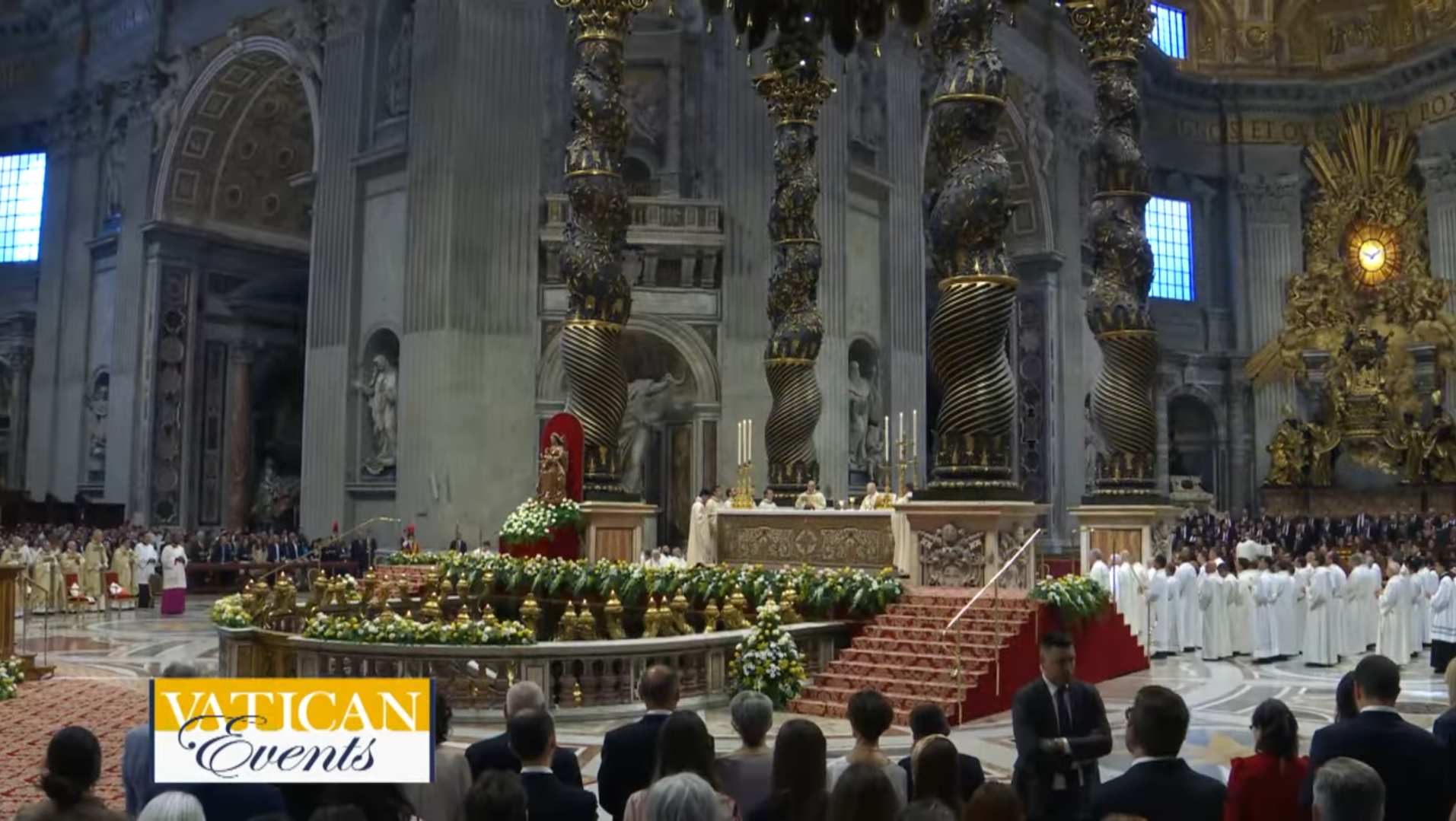
In his homily during today’s Mass of Presbyteral Ordinations in St. Peter’s Basilica, Pope Leo XIV called the Church to joy, unity, and mission, urging newly ordained priests to be men of communion who reflect God’s hope in a wounded world.
Addressing the ordinands on the Feast of the Visitation, the Pope emphasized the inseparable link between priestly identity and belonging to the people of God. “The depth, breadth, and even the duration of the divine joy we now share,” he said, “is directly proportional to the bonds that exist and will grow between you and the people.”
Rooted in the Second Vatican Council’s vision of a pilgrim people, the Holy Father described priesthood not as a private possession but as a service to a dynamic and diverse body called together by God. “Being of God binds us to the earth,” he stressed, “not to an ideal world, but to the real world.”
Citing Pope Francis’s warnings against clerical self-referentiality, the Holy Father encouraged the new priests to remain transparent, credible, and close to the people. “Known lives, readable lives, credible lives!” he declared, highlighting the need to rebuild the Church’s credibility through authentic witness.
With reference to the Gospel and the Acts of the Apostles, the Holy Father reminded the faithful that priestly ministry is not about power or privilege, but about being “guardians, not masters” of the mission that belongs to Christ alone. “The Holy Spirit has set you up as guardians,” he quoted St. Paul, stressing that Christ is alive and goes before his Church.
The Pope concluded with a Marian exhortation, invoking Mary as “Our Lady of Trust and Mother of Hope,” and affirming that the newly ordained, by their life of service, participate in uniting heaven and earth. “We are of God,” he said. “There is no greater wealth to appreciate and participate.”

Holy Mass with Presbyteral Ordinations
“Dear brothers and sisters!
Today is a day of great joy for the Church and for each one of you, you order priests, together with family, friends and companions on your journey in the years of formation. As the Rite of Ordination highlights in several passages, the relationship between what we celebrate today and the people of God is fundamental. The depth, breadth, and even the duration of the divine joy that we now share is directly proportional to the bonds that exist and will grow between you and the people from whom you come from, of which you remain part and to which you are sent. I will dwell on this aspect, always bearing in mind that the identity of the priest depends on union with Christ the high and eternal priest.
We are God’s people. The Second Vatican Council made this awareness more alive, almost anticipating a time when the belongings would become weaker and the sense of God more rarefied. You are testimony to the fact that God did not tire of gathering his children, albeit different, and to constitute them in a dynamic unity. It is not an impetuous action, but a matter of that light breeze that gives hope to the prophet Elijah at the hour of discouragement (cf. 1 Kings 19:12). The joy of God is not noisy, but it really changes history and brings us closer to each other. The mystery of the Visitation is an icon of this, which the Church contemplates on the last day of May. From the encounter between the Virgin Mary and her cousin Elizabeth we see the Magnificat, the song of a people visited by grace.
The newly proclaimed readings help us to interpret what is happening between us. Jesus, first of all, in the Gospel does not appear to us crushed by the imminent death, nor by the disappointment of the bonds broken or remained unfinished. The Holy Spirit, on the contrary, intensifies those threatened bonds. In prayer they become stronger than death. Instead of thinking of his own personal destiny, Jesus puts in the hands of the Father the bonds he built here below. We’re part of it! The Gospel, in fact, has come to us through bonds that the world can wear down, but not destroy.
Dear orders, then conceive of yourselves in the way of Jesus! Being of God – servants of God, the people of God – binds us to the earth: not to an ideal world, but to the real world. Like Jesus, those in the flesh are those that the Father puts on your way. To them you consecrate yourselves, without separating it, without isolating yourselves, without making the gift received a sort of privilege. Pope Francis has warned us many times against this, because self-referentiality extinguishes the fire of the missionary spirit.
The Church is constitutively extroverted, as extroverts are the life, passion, death and resurrection of Jesus. You will make your words in every Eucharist: it is “for you and for all”. No one has ever seen God. He turned to us, he came out of his own. The Son became his exegesis, the living story. And he gave us the power to become children of God. Don’t look, we seek no more power!
The gesture of the laying on of hands, with which Jesus welcomed children and healed the sick, renew in you the liberating power of his messianic ministry. In the Acts of the Apostles that we will repeat soon is the transmission of the Creator Spirit. Thus, the Kingdom of God now puts your personal freedoms in communion, willing to come out of themselves, grafting your intelligences and your young forces in the Jubilee mission that Jesus transmitted to his Church.
In his greeting to the elders of the community of Ephesus, of whom we have heard some fragments in the first reading, Paul transmits to them the secret of every mission: “The Holy Spirit has set you up as guardians” (Acts 20:28). Not masters, but guardians. The mission is of Jesus. He is risen, so he is alive and he is before us. None of us are called to replace him. The day of Ascension educates us in his invisible presence. He trusts us, he makes room for us; he even came to say: “It is good for you that I leave” (Jn 16:7). We Bishops too, dear ordinands, involve yourselves in the mission today make room for you. And you make room for the faithful and every creature, to whom the Risen One is near and in whom he loves to visit and amaze us. God’s people are more numerous than we see. Let’s not define its boundaries.
Of St. Paul, of his heartwarming farewell speech, I would like to underline a second word. It actually precedes all the others. He can say, “You know how I have been with you all this time” (Acts 20:18). We keep this expression in the heart and mind, well-carved! “You know how I behaved”: the transparency of life. Known lives, readable lives, credible lives! We are within the people of God, in order to stand before them, with a credible testimony.
Together, then, we will rebuild the credibility of a wounded Church, sent to a wounded humanity, within a wounded creation. We are not perfect yet, but we need to be credible.
The Risen Jesus shows us his wounds and, despite being a sign of rejection by humanity, forgives us and sends us. Let’s not forget that! He also blows on us today (cf. Jn 20:22) and makes us ministers of hope. “So let us no longer look at anyone in the human way” (2 Cor 5:16): all that appears broken and lost in our eyes now appears to us in the sign of reconciliation.
“The love of Christ possesses us”, dear brothers and sisters! It is a possession that frees us and that enables us to possess no one. Free up, not to own. We are of God: there is no greater wealth to appreciate and participate. It is the only wealth that, shared, multiplies. Together we want to bring her into the world that God loved so much that she gave her only Son (cf. Jn 3:16).
Thus, the life given by these brothers and sisters is full of meaning, which will soon be ordained priests. We thank them and we thank God who called them at the service of a whole priestly people. Together, in fact, we unite heaven and earth. In Mary, Mother of the Church, this common priesthood shines, which raises the humble, binds the generations, makes us call blessed (cf. Lk 1:48, 52). May she, Our Lady of Trust and Mother of Hope, intercede for us.”