
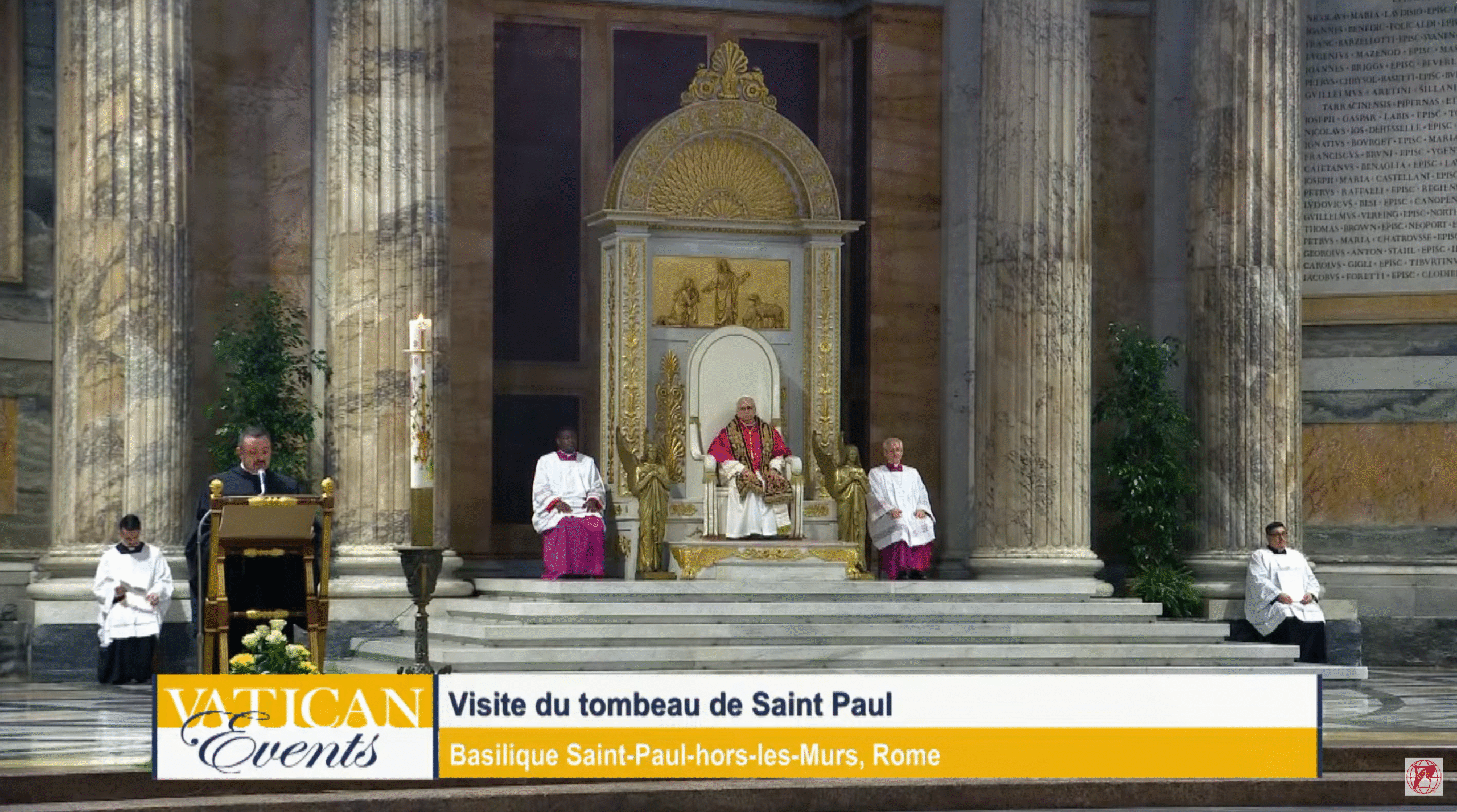
In a solemn homily delivered at the Tomb of St. Paul, Pope Leo XIV inaugurated his pontificate by reflecting on the Apostle’s message of grace, faith, and justification. Citing the opening verses of Paul’s Letter to the Romans, the Pope invited the Church to entrust this new chapter to God’s mercy and the intercession of the Apostle of the Gentiles.
The Holy Father emphasized that vocation begins with grace — a divine initiative, not human merit — and recalled both St. Paul’s conversion and St. Augustine’s insight that “we cannot love, unless someone has loved us first.”
Touching on “the obedience of faith,” the Pope underlined the harmony between divine grace and human freedom, urging believers to emulate Paul’s courageous response to God’s call. “Salvation does not come about by magic,” he said, “but by a mysterious interplay of grace and faith.”
He concluded with a call to fraternal charity and missionary zeal, drawing on the legacy of Saint Benedict and quoting Pope Benedict XVI: “God loves us. This is the great truth of our life.”
“May the Lord grant me the grace to respond faithfully to his call,” the Holy Father said.

HOMILY OF HIS HOLINESS POPE LEO XIV
“The passage of Scripture that we have just heard is the opening of a beautiful letter written by Saint Paul to the Christians of Rome. Its message revolves around three great themes: grace, faith and justification. As we entrust the beginning of this new Pontificate to the intercession of the Apostle of the Gentiles, let us reflect together on that message.
Saint Paul starts by saying that he received from God the grace of his vocation (cf. Rom 1:5). He acknowledges, in other words, that his encounter with Christ and his own ministry were the fruit of God’s prior love, which called him to a new life while he was still far from the Gospel and persecuting the Church. Saint Augustine, who was also a convert, spoke of the same experience in these words: “How can we choose, unless we have first been chosen? We cannot love, unless someone has loved us first” (Serm. 34, 2). At the root of every vocation, God is present, in his mercy and his goodness, as generous as that of a mother (cf. Is 66:11-13) who nourishes her child with her own body for as long as the child is unable to feed itself (cf. SAINT AUGUSTINE, Enn. in Ps. 130, 9).
In the same passage, Paul also speaks of “the obedience of faith” (Rom 1:5), and here too he shares his own experience. When the Lord appeared to him on the road to Damascus (cf. Acts 9:1-30), he did not take away his freedom, but gave him the opportunity to make a decision, to choose an obedience that would prove costly and entail interior and exterior struggles, which Paul proved willing to face. Salvation does not come about by magic, but by a mysterious interplay of grace and faith, of God’s prevenient love and of our trusting and free acceptance (cf. 2 Tim 1:12).
As we thank the Lord for the calling that changed Saul’s life, let us ask him to enable us to respond in the same way to his grace, and to become, ourselves, witnesses of the love “poured into our hearts through the Holy Spirit who has been given to us” (Rom 5:5). Let us ask the Lord for the grace to cultivate and spread his charity, and to become true neighbours to one another (cf. FRANCIS, Homily at Second Vespers of the Solemnity of the Conversion of Saint Paul, 25 January 2024). Let us compete in showing the love that, following his encounter with Christ, drove the former persecutor to become “all things to all people” (cf. 1 Cor 9:19-23), even to the point of martyrdom. In this way, for us as for Paul, the weakness of the flesh will show the power of faith in God that brings justification (cf. Rom 5:1-5).
For centuries, this Basilica has been entrusted to the care of a Benedictine community. How can we fail to mention, then, as we speak of love as the source and driving force of the preaching of the Gospel, the insistent appeals of Saint Benedict, in his Rule, to fraternal charity in the monastery and hospitality towards all (Rule, cc. LIII; LXIII).
I would like to conclude, though, by recalling the words that, more than a thousand years later, another Benedict, Pope Benedict XVI, addressed to young people: “Dear friends,” he said, “God loves us. This is the great truth of our life; it is what makes everything else meaningful.” Indeed, “our life originates as part of a loving plan of God,” and faith leads us to “open our hearts to this mystery of love and to live as men and women conscious of being loved by God” (Homily at the Prayer Vigil with Young People, Madrid, 20 August 2011).
Here we see, in all its simplicity and uniqueness, the basis of every mission, including my own mission as the Successor of Peter and the heir to Paul’s apostolic zeal. May the Lord grant me the grace to respond faithfully to his call.”