
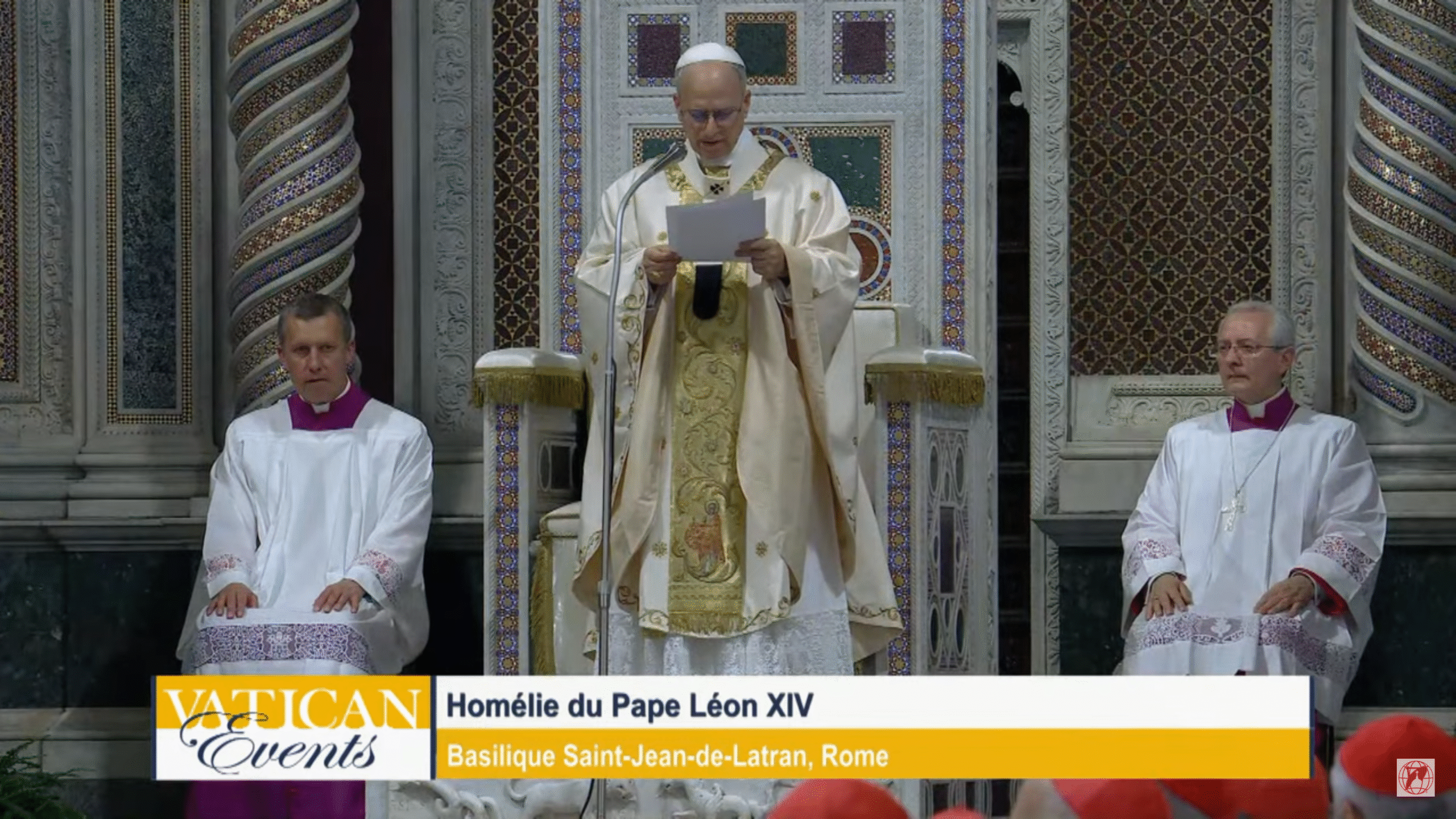
In a deeply pastoral and evocative homily delivered during his Mass of Possession at the Archbasilica of San Giovanni in Laterano, Pope Leo XIV set the tone for his ministry as Bishop of Rome by highlighting the Church’s maternal identity and its mission of listening, unity, and synodal dialogue.
Addressing an assembly that included cardinals, bishops, clergy, religious, civic authorities, and lay faithful, the Holy Father extended a heartfelt greeting, paying special attention to those engaged in pastoral care across the Diocese of Rome. The Basilica, the Pope noted, is not only the cathedral of Rome but also bears a unique responsibility as Mater omnium Ecclesiarum—“Mother of all the Churches.”
Echoing the legacy of Pope Francis, Pope Leo cited Evangelii Gaudium and prior catecheses to encourage the Church in Rome to embody the tender and proactive qualities of a mother: “tenderness, self-sacrifice, and the capacity to listen.” He expressed a desire that these traits become even more visible across all levels of the diocesan community, beginning with himself.
Drawing from the day’s readings, particularly Acts 15, the Pope reflected on the early Church’s struggle to integrate Gentile converts. He portrayed the Jerusalem Council not merely as an institutional decision but as an act of spiritual discernment rooted in humility and listening—both to the Holy Spirit and to one another. “It seemed good to the Holy Spirit and to us,” he quoted from the Acts, emphasizing that true communion is born “on our knees”—through prayer, discernment, and conversion of heart.
He referenced the Gospel passage from John 14, which describes the Spirit as teacher and reminder of Christ’s words. The Pope portrayed this dynamic as central to Christian maturity: “The more we let ourselves be transformed by the Gospel… the more capable we are of proclaiming its message.”
Pope Leo spoke warmly of the Diocese of Rome’s efforts in recent years to undertake a “challenging process of listening,” affirming the local Church’s courage to think boldly and engage complex realities. He praised its initiatives during the current Jubilee Year, especially the hospitality shown to pilgrims, which he said made the city resemble “a wide, open and welcoming home.”
In a personal and humble tone, the Pope vowed to contribute to this ongoing synodal journey by listening and discerning alongside his people. Citing Saint Augustine, he promised to be “a Christian with you and a Bishop for you,” and turned to Saint Leo the Great to remind his listeners that all ministerial fruitfulness comes from Christ, not personal merit.
Pope Leo concluded with a moving reference to Blessed John Paul I’s first address to his diocesan family, echoing the same simplicity and affection: “I too offer you ‘the little I have and am,’” entrusting his ministry to the intercession of Saints Peter and Paul and the Blessed Mother.
In this inaugural homily as Bishop of Rome, Pope Leo XIV offered a vision of ecclesial leadership rooted in prayerful discernment, shared responsibility, and maternal care—hallmarks of a pontificate seemingly intent on deepening the Church’s mission in a spirit of unity and love.

HOMILY OF THE HOLY FATHER LEO XIV AT THE PAPAL MASS FOR THE POSSESSION OF THE CHAIR OF THE BISHOP OF ROME
“I offer a cordial greeting to the Cardinals present, and particularly to the Cardinal Vicar, the auxiliary bishops, all the bishops and the priests – parish priests, parochial vicars and all those who in in various ways cooperate in the pastoral care of our communities. My greeting also goes to the deacons, the men and women religious, the civil authorities and all of you, the dear lay faithful.
The Church of Rome is heir to a great history, grounded in the witness of Peter, Paul and countless martyrs, and it has a unique mission, as we see from the inscription on the façade of this Cathedral: to be Mater omnium Ecclesiarum, Mother of all the Churches.
Pope Francis frequently encouraged us to reflect on the maternal dimension of the Church (cf. Evangelii Gaudium, 46-49,139-141; Catechesis, 13 January 2016) and her defining qualities of tenderness, self-sacrifice and the capacity to listen. Those qualities enable her not only to assist others but often to anticipate their needs and expectations before they are even expressed. We hope that those qualities will be increasingly present in the people of God everywhere, including here, in our great diocesan family: in the faithful, in pastors, and, first of all, in myself. The readings we have heard can help us to reflect on these qualities.
The Acts of the Apostles (cf. 15:1-2, 22-29) in particular describe how the early Christian community faced the challenge of opening to the pagan world in its preaching of the Gospel. This was no easy matter; it called for much patience and mutual listening. This was the case in the community in Antioch, where the brethren, through dialogue – and even disagreements – resolved the question together. Paul and Barnabas then went up to Jerusalem. They did not settle the question on their own: they wanted to be in communion with the Mother Church and so they went there with humility.
In Jerusalem, they found Peter and the Apostles, who were prepared to listen to them. This was the beginning of a dialogue that, in the end, led to the right decision. Recognizing the difficulties of the new converts, they agreed not to impose excessive burdens on them, but rather to insist only on what was essential (cf. Acts 15:28-29). In this way, what might have seemed a problem became for everyone an opportunity for reflection and growth.
The biblical text, however, tells us something else, beyond the rich and interesting human dynamics of the event.
We see this in the words used by the brethren in Jerusalem to communicate their decisions to those in Antioch. They wrote: “For it has seemed good to the Holy Spirit and to us” (cf. Acts 15:28). In other words, they emphasized that the most important part of the entire event was listening to God’s voice, which made everything else possible. In this way, they remind us that communion is built primarily “on our knees,” through prayer and constant commitment to conversion. For only in this way can each of us hear within the voice of the Spirit crying out: “Abba! Father!” (Gal 4:6) and then, as a result, listen to and understand others as our brothers and sisters.
The Gospel reaffirms this point (cf. Jn 14:23-29). It assures us that we are not alone in making our decisions in life. The Spirit sustains us and shows us the way to follow, “teaching” us and “reminding” us of all that Jesus said to us (cf. Jn 14:26).
First, the Spirit teaches us the Lord’s words by impressing them deep within us, written, as the biblical image would have it, no longer on tablets of stone but in our hearts (cf. Jer 31:33). This gift helps us grow and become “a letter of Christ” (cf. 2 Cor 3:3) for one another. Naturally, the more we let ourselves be convinced and transformed by the Gospel — allowing the power of the Spirit to purify our heart, to make our words straightforward, our desires honest and clear, and our actions generous — the more capable we are of proclaiming its message.
Here, the other verb comes into play: we remember, that is, we reflect in our hearts upon what we have experienced and learned, in order to understand more fully its meaning and to savour its beauty.
I think in this regard of the challenging process of listening that the Diocese of Rome has undertaken in these years, a process carried out at various levels: listening to the world around us to respond to its challenges, and listening within our communities to understand needs and to propose sage and prophetic initiatives of evangelization and charity. This has been a challenging, ongoing journey meant to embrace a very rich and complex reality. Yet it is worthy of the history of this local Church, which has shown, time and again, that it is able to “think big”, unafraid to embark on bold projects and to confront new and challenging scenarios.
This is evident in the great efforts and many initiatives that the Diocese has made to welcome and provide for the needs of pilgrims during the present Jubilee. Thank you! These have made the city of Rome appear to visitors, some of whom have travelled from far away, as a wide, open and welcoming home, and above all as a place of deep faith.
For my part, I would like to express my firm desire to contribute to this great ongoing process by listening to everyone as much as possible, in order to learn, understand and decide things together, as Saint Augustine would say, “as a Christian with you and a Bishop for you” (cf. Serm. 340, 1). I would also ask you to support me in prayer and charity, mindful of the words of Saint Leo the Great: “All the good we do in the exercise of our ministry is the work of Christ and not our own, for we can do nothing without him. Yet we glory in him, from whom all the effectiveness of our work is derived” (Serm. 5, De Natali Ipsius, 4).
Let me conclude by adding the words with which Blessed John Paul I, whose joyful and serene face had already earned him the nickname of “the smiling Pope,” greeted his new diocesan family on 23 September 1978. “Saint Pius X,” he said, “upon entering Venice as patriarch, exclaimed in Saint Mark’s: ‘What would become of me, dear Venetians, if I did not love you?’ I would say something similar to you Romans: I assure you that I love you, that I desire only to enter into your service and to place my own poor abilities, the little I have and am, at the service of all” (Homily for the Taking of Possession of the Chair of the Bishop of Rome).
I too express my affection for you and my desire to share with you, on our journey together, our joys and sorrows, our struggles and hopes. I too offer you “the little I have and am,” entrusting it to the intercession of Saints Peter and Paul and of all those other brothers and sisters of ours whose holiness has illuminated the history of this Church and the streets of this city. May the Virgin Mary accompany us and intercede for us.”