
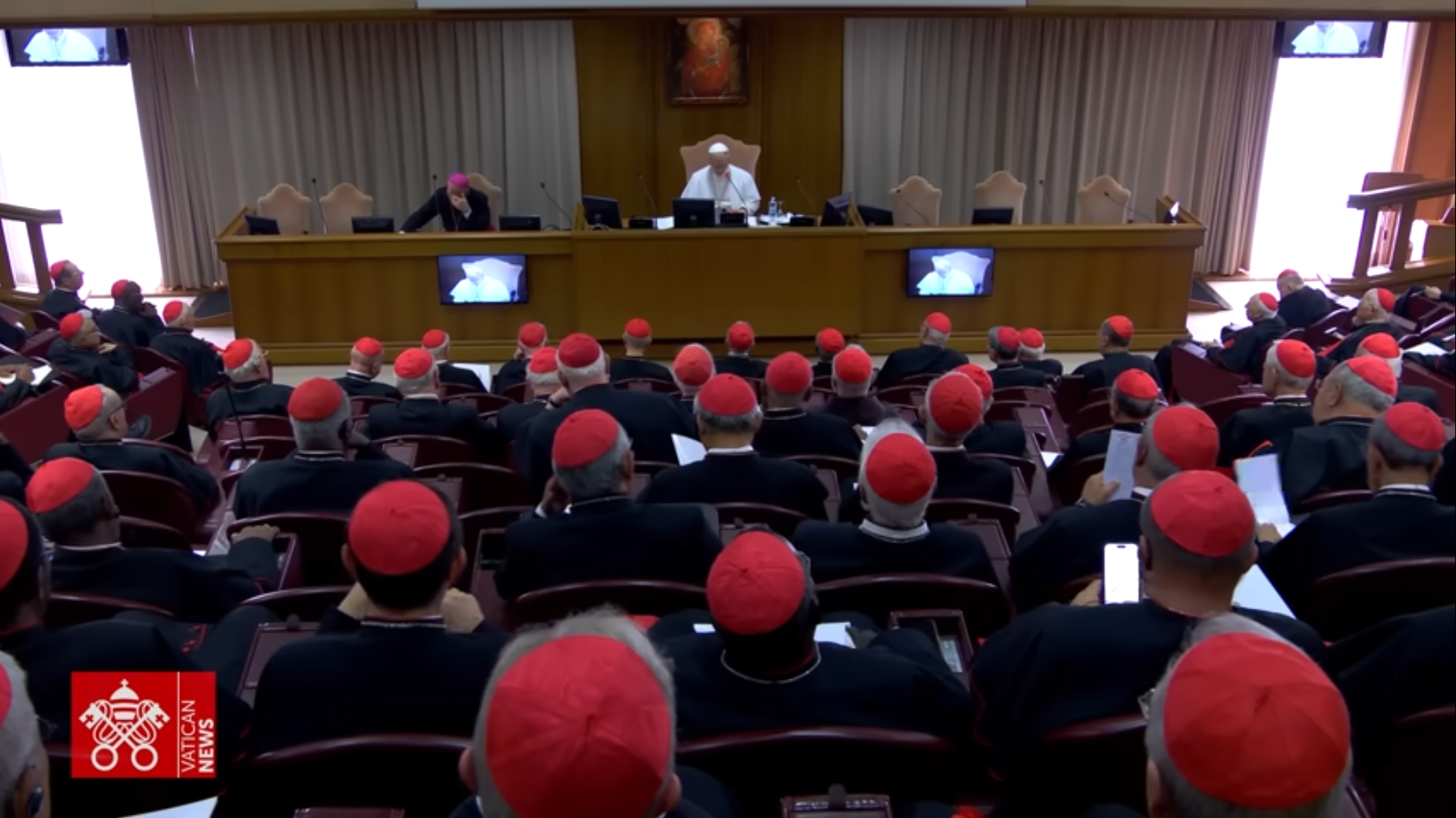
In his address to the College of Cardinals this morning, Pope Leo XIV struck a tone of humility, continuity, and hope, calling for renewed faith, missionary zeal, and a commitment to the principles laid down by the Second Vatican Council. The newly elected Pontiff, who succeeds Pope Francis, offered heartfelt thanks, remembered his predecessor with reverence, and pointed to pressing contemporary challenges—including artificial intelligence—as arenas for the Church’s renewed social engagement.
Acknowledging the weight of the moment, Pope Leo referred to the days following Pope Francis’s death as “sad and demanding,” but also “rich in grace and consolation in the Spirit.” Quoting the Gospel of John, he reminded the cardinals that even in sorrow, the promise of Christ endures.
In a deeply personal reflection, the Pope described his election as a “yoke far beyond my own limited powers,” and looked to his brother cardinals for spiritual and pastoral support. “The Lord… will not leave me alone,” he said, affirming his reliance on divine grace and the solidarity of the Church’s leadership.
The Holy Father also expressed his “deep gratitude” to Cardinal Giovanni Battista Re, the Dean of the College, and Cardinal Kevin Farrell, the Camerlengo, for their leadership during the period of sede vacante. He paused to remember cardinals unable to attend due to illness and emphasized the unity of the Church in prayer.
In his remarks, the Pope framed the death of Pope Francis and the Conclave as a “paschal event,” a spiritual passage imbued with both grief and the promise of resurrection. He spoke of Pope Francis’s legacy with reverence: “His example of complete dedication to service and to sober simplicity of life… his serene trust at the moment of his return to the Father’s house.”
Drawing on biblical imagery, Pope Leo described the Church as a “flock,” a “field,” and “the womb from which we were born.” He praised the global Catholic community for its devotion during the mourning period, highlighting the “grandeur of the Church” in its unity under Christ, the “shepherd and guardian” of souls.
In a clear affirmation of his papal priorities, Pope Leo called for renewed commitment to the post-conciliar path traced by Vatican II and powerfully advanced by Pope Francis. Citing Evangelii Gaudium, he emphasized the primacy of Christ, missionary conversion, synodality, the sensus fidei, care for the marginalized, and open dialogue with the modern world.
“These are evangelical principles,” he said, “that have always inspired and guided the life and activity of God’s Family.” Echoing themes from both Pope Benedict XVI and Pope Francis, Pope Leo underscored the Church’s role as a beacon of hope to all who seek “truth, justice, peace and fraternity.”
The Pontiff also explained his choice of the name Leo XIV, aligning himself with Pope Leo XIII, who issued the landmark encyclical Rerum Novarum in 1891. That document addressed the upheavals of the industrial age with a pioneering call for labor rights and social justice. Now, the Holy Father indicated, the Church must offer similar moral clarity amid “a new industrial revolution” and the rise of artificial intelligence. “These developments pose new challenges for the defense of human dignity, justice and labor,” he warned.
He concluded by invoking the words of Saint Paul VI at the beginning of his papacy: a hope for faith and love “to pass over the whole world like a great flame.” The Pope urged the cardinals to transform that hope into concrete prayer and action, guided always by the strength of God.
With this address, Pope Leo XIV has signaled both deep continuity and renewed momentum for a Church at the crossroads of tradition and innovation. As he begins his Petrine ministry, his vision is unmistakably clear: a Church faithful to its roots, energized for mission, and open to the grace of the present moment.

ADDRESS OF HIS HOLINESS POPE LEO XIV TO THE COLLEGE OF CARDINALS
“Thank you very much, Your Eminence. Before taking our seats, let us begin with a prayer, asking the Lord to continue to accompany this College, and above all the entire Church with this spirit, with enthusiasm, but also with deep faith. Let us pray together in Latin.
Pater noster… Ave Maria…
In the first part of this meeting, there will be a short talk with some reflections that I would like to share with you. But then there will be a second part, a bit like the opportunity that many of you had asked for: a sort of dialogue with the College of Cardinals to hear what advice, suggestions, proposals, concrete things, which have already been discussed in the days leading up to the Conclave.
Dear Brother Cardinals,
I greet all of you with gratitude for this meeting and for the days that preceded it. Days that were sad because of the loss of the Holy Father Pope Francis and demanding due to the responsibilities we confronted together, yet at the same time, in accordance with the promise Jesus himself made to us, days rich in grace and consolation in the Spirit (cf. Jn 14:25-27).
You, dear Cardinals, are the closest collaborators of the Pope. This has proved a great comfort to me in accepting a yoke clearly far beyond my own limited powers, as it would be for any of us. Your presence reminds me that the Lord, who has entrusted me with this mission, will not leave me alone in bearing its responsibility. I know, before all else, that I can always count on his help, the help of the Lord, and through his grace and providence, on your closeness and that of so many of our brothers and sisters throughout the world who believe in God, love the Church and support the Vicar of Christ by their prayers and good works.
I thank the Dean of the College of Cardinals, Cardinal Giovanni Battista Re – who deserves applause, at least once, if not more – whose wisdom, the fruit of a long life and many years of faithful service to the Apostolic See, has helped us greatly during this time. I thank the Camerlengo of the Holy Roman Church, Cardinal Kevin Joseph Farrell – I believe he is present today – for the important and demanding work that he has done throughout the period of the Vacant See and for the convocation of the Conclave. My thoughts also go to our brother Cardinals who, for reasons of health, were unable to be present, and I join you in embracing them in communion of affection and prayer.
At this moment, both sad and joyful, providentially bathed in the light of Easter, I would like all of us to see the passing of our beloved Holy Father Pope Francis and the Conclave as a paschal event, a stage in that long exodus through which the Lord continues to guide us towards the fullness of life. In this perspective, we entrust to the “merciful Father and God of all consolation” (2 Cor 1:3) the soul of the late Pontiff and also the future of the Church.
Beginning with Saint Peter and up to myself, his unworthy Successor, the Pope has been a humble servant of God and of his brothers and sisters, and nothing more than this. It has been clearly seen in the example of so many of my Predecessors, and most recently by Pope Francis himself, with his example of complete dedication to service and to sober simplicity of life, his abandonment to God throughout his ministry and his serene trust at the moment of his return to the Father’s house. Let us take up this precious legacy and continue on the journey, inspired by the same hope that is born of faith.
It is the Risen Lord, present among us, who protects and guides the Church, and continues to fill her with hope through the love “poured into our hearts through the Holy Spirit who has been given to us” (Rom 5:5). It is up to us to be docile listeners to his voice and faithful ministers of his plan of salvation, mindful that God loves to communicate himself, not in the roar of thunder and earthquakes, but in the “whisper of a gentle breeze” (1 Kings 19:12) or, as some translate it, in a “sound of sheer silence.” It is this essential and important encounter to which we must guide and accompany all the holy People of God entrusted to our care.
In these days, we have been able to see the beauty and feel the strength of this immense community, which with such affection and devotion has greeted and mourned its Shepherd, accompanying him with faith and prayer at the time of his final encounter with the Lord. We have seen the true grandeur of the Church, which is alive in the rich variety of her members in union with her one Head, Christ, “the shepherd and guardian” (1 Peter 2:25) of our souls. She is the womb from which we were born and at the same time the flock (cf. Jn 21:15-17), the field (cf. Mk 4:1-20) entrusted to us to protect and cultivate, to nourish with the sacraments of salvation and to make fruitful by our sowing the seed of the Word, so that, steadfast in one accord and enthusiastic in mission, she may press forward, like the Israelites in the desert, in the shadow of the cloud and in the light of God’s fire (cf. Ex 13:21).
In this regard, I would like us to renew together today our complete commitment to the path that the universal Church has now followed for decades in the wake of the Second Vatican Council. Pope Francis masterfully and concretely set it forth in the Apostolic Exhortation Evangelii Gaudium, from which I would like to highlight several fundamental points: the return to the primacy of Christ in proclamation (cf. No. 11); the missionary conversion of the entire Christian community (cf. No. 9); growth in collegiality and synodality (cf. No. 33); attention to the sensus fidei (cf. Nos. 119-120), especially in its most authentic and inclusive forms, such as popular piety (cf. No. 123); loving care for the least and the rejected (cf. No. 53); courageous and trusting dialogue with the contemporary world in its various components and realities (cf. No. 84; Second Vatican Council, Pastoral Constitution Gaudium et Spes, 1-2).
These are evangelical principles that have always inspired and guided the life and activity of God’s Family. In these values, the merciful face of the Father has been revealed and continues to be revealed in his incarnate Son, the ultimate hope of all who sincerely seek truth, justice, peace and fraternity (cf. Benedict XVI, Spe Salvi, 2; Francis, Spes Non Confundit, 3).
Sensing myself called to continue in this same path, I chose to take the name Leo XIV. There are different reasons for this, but mainly because Pope Leo XIII in his historic Encyclical Rerum Novarum addressed the social question in the context of the first great industrial revolution. In our own day, the Church offers to everyone the treasury of her social teaching in response to another industrial revolution and to developments in the field of artificial intelligence that pose new challenges for the defense of human dignity, justice and labor.
Dear brothers, I would like to conclude the first part of our meeting by making my own – and proposing to you as well – the hope that Saint Paul VI expressed at the inauguration of his Petrine Ministry in 1963: “May it pass over the whole world like a great flame of faith and love kindled in all men and women of good will. May it shed light on paths of mutual cooperation and bless humanity abundantly, now and always, with the very strength of God, without whose help nothing is valid, nothing is holy” (Message Qui Fausto Die addressed to the entire human family, 22 June 1963).
May these also be our sentiments, to be translated into prayer and commitment, with the Lord’s help. Thank you!”